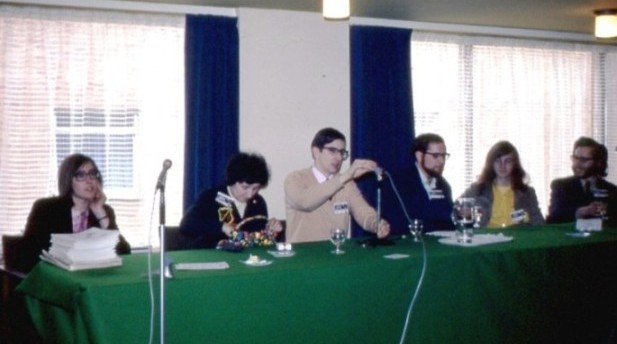
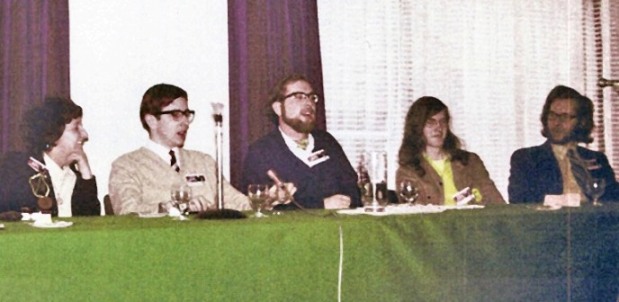
THE FANZINE PANELTranscribed by Graham Boak. Editorial comments in italics are his.
PETER WESTON: You've heard quite enough from me, so I'll keep my introduction short. Up here is myself; Ethel, 15 years before the mast (or 16 coming up now) with SCOTTISHE and one or two others; Malcolm Edwards, new boy, QUICKSILVER (Aldiss, Moorcock, Priest.... that crowd); Graham Boak, CYNIC - Britain's fannish fanzine (at least I look at it that way); Peter Roberts, who'll probably argue with me because he does one as well, EGG; and Darrol Pardoe, who is of considerable vintage. Darroll was a member of the old Stourtbridge Circle, with Ken Cheslin. Ken started LES SPINGE, which was a marvellously scruffy fanzine. It's going strong - well, it's still going. Dave Hale took over it, made it a beautiful immaculate thing - spent a fortune on it. Darroll then inherited the mantle, producing SPINGE irregularly but of high quality. Now, I'll ask each of the people here, why do you publish? There must be some reason. Nobody would be crazy enough to spend this amount of time if they didn't get something out of it. And then I'd like to throw this back at the audience... ((But didn't!)) What do you get out of fandom - fanzine fandom, if you like. Most of you have seen fanzines, have read fanzines. What do you get out of it? What do you think of them? ETHEL LINDSAY: The reason I put out a fanzine is for my personal satisfaction. If the people who read it also enjoy it, well, that's very nice, but the first thing my fanzine must do is please me, because I am not going to make a profit out of it and therefore I don't have to please the readers. If some will give me money for it, jolly good luck to them, but they are going to have to realise that the first rule is "what goes into my fanzine is what I want to see there. So it's of no use saying "what do you want to give to the people reading it?" because this is one place in the whole of your life where you have complete responsibility, where you don't have to give way to other people's thoughts and desires. It's a personal. thing, and what you get back in return, of course, various people have various things, but what I have got back is a group 'of very, very good friends - some of whom I have never met, but fortunately a lot of them I have. But I do have friends through putting out my fanzine, who are very good friends, who have really enriched my life, because I happened to "hit it off" with them through the things that I write in my fanzine. And that's the' biggest reward I get. PETER WESTON: Perhaps everyone else on the panel will want to say just the same thing as Ethel, so I'll slightly rephrase the question. What do you think, Malcolm and the others, are you dealing with in your own fanzine? Everyone is different, we're all trying to do something a little different. MALCOLM EDWARDS: As I suspected, this has turned into a great opportunity for self-advertisement, so if any of you haven't seen this.... ((Whereupon he proceeded to advertise Quicksilver. Mercenary sercon swine! However, within these pages the editorial red corflu reigns supreme.)) ....QUICKSILVER, so they tell me, is a Sercon zine, which if you don't know - and I suspect you do - is serious and constructive, which means it has something to say about SF. I think that the reason that I do it is tied up with the way that term is used in this country. The way I see it, the connotations of a sercon zine involve a kind of ludicrous over-earnestness in taking SF too seriously, which it is possible to do, and making a fool of yourself in doing so. In England, it seems that any fanzine which actually tries to deal. with science fiction, and tries to deal with it at any level above the trivial, just giving plot summaries of books and saying, "well, this is a great book; this is a rotten book" is regarded as somehow an over-earnest activity not really worth doing: it's a very sad state of affairs which doesn't exist in America, and is one of the reasons why British fandom is in a rotten state.
((If true, lamentable...but I don't believe it. The reason for British fandom's failings is sheer lack of talent.)) And since the only magazine I could find which was actually devoted to this was Pete's SPECULATION, and I don't agree with everything it says in SPECULATION, I decided to do one which would have things that I would agree with. PETER WESTON: I think that's shameful, publishing a fanzine all of your own opinions. I don't agree with everything that's said in SPECULATION either. Incidentally, I said at the convention to Malcolm that only a neofan publishes a special issue of a fanzine to bring to a convention, because they always get lost. Now Ethel has done the same thing.... GRAY BOAK: Some people produce fanzines from a science fiction point of view; I produce mine from the fandom point of view. I thought that there were several magazines going which were talking about science fiction: criticism, reviews. I read SPECULATION. Pam Bulmer's stuff - I thought "I can't do that!" It's too good for me. As was said about C.S. Lewis's books. He wrote them because that's the sort of thing he wanted to read. So I started doing a fanzine about fandom, because that's what I wanted to see in fanzines. I wanted to know what fans were doing apart from at cons - I can meet them there, but the rest of the time they disappear. Fanzines used to give an idea of what was happening in the country; what fans thought about science-fiction (amongst other things), how they lived their lives, their interests, their companions (if you like, other fans who lived nearby)... this sort of thing is not being shown in fanzines nowadays. I thought - aha! there's a gap, that's what I want to read, that's what I set out to do. Preferably with a touch of humour, which may not always work but I do try. A light-hearted look at what fans do when they're not being Mundanes. ((If only C. was like that....)) PETER ROBERTS: Ethel was saying that she produced her fanzine because it was her own personal writing - this was what she wanted to do. I think the reason why I produced *all* my fanzines was to contact other fans. I live alone in Bristol. There are no other fans in Bristol, I don't know why but that's how it goes. The only time I can meet other fans is at a convention. Obviously, unless you're a millionaire and can travel around, that's all you can do. So my main reason for publishing was to contact other fans, to get letters of comment back and just to produce something that other people would like to read, that they would like to comment on. And just generally to contact people... EGG in particular: I felt as Graham does, that there was a gap. Britain used to be famous for its fannish fanzines, like the inevitable HYPHEN, and recently you get things like SPECULATION. They're fine enough, but there's nothing left now of the fannish fanzines of the past - except a few in OMPA, SCOTTISHE perhaps, and Graham's new one. I still think that this is the most important sector of fanzine publishing. The fannish side, not the sercon. Although the two can ((must!)) live side by side. ((Fannish fanzines are what makes fandom something special in itself - not merely a parasite on science-fiction.)) DARROLL PARDOE: I long ago found out that you can't please everybody with an issue of a fanzine, so what I've tried to do with SPINGE in recent years is to write at least something in every issue that somebody can like; to provide a cross-section of material as big as I can, so that people won't write in and say "I was bored by the whole thing" but they might write in and say "I was bored by it except X". So, rather than try to please everybody all the time, I try to please everybody with at least one item in the issue. I don't mention science fiction very much, because I leave that sort of thing to the acknowledged masters, but I suppose my fanzine is what you'd call a fannish fanzine, rather than a serious and constructive one. My basic philosophy is to, as I said, provide something from everybody and package it as well as I can within the limitations of the media. PETER WESTON: I'm glad we had Darroll last because he brought up an interesting point. Each of the others has adopted a different philosophy to Darroll, I think I'm correct: we're each trying to do one specific thing for a band of people, so that the people who get it will like everything in that issue, and the people who don't like it will like nothing in it. That's a vertical, if you like, using a mundane term, vertical coverage; Darroll's doing a horizontal coverage. He's trying to have a very wide bunch of people getting it with all sorts of interests, and be hopes that none will be dissatisfied. There's a fundamental difference. I think we can work in a discussion, somewhere. The thing I was going to say before - I'm the only one here that's published a really horrible first issue. ETHEL LINDSAY: Oh no you're not. Oh no you're not! PETER WESTON: ...on the panel. Darroll's first issue - well, I don't remember Darroll's first, lost in the mists of time - and as for Ethel's .... I don't believe her first issue was anything other than impeccable. Malcolm's sickened me, as a first issue ... James Blish said "easily the best science fiction fanzine since SFR was revived" (which is a nasty thing to say); and Graham did a very good ... very good indeed, I thought, whichever his first issue was. Graham has an annoying habit of starting about six fanzines at once, and publishing the first issue of each, with the wrong covers on. Every time. But whichever was his first issue it was bloody good. And Peter, his first issue, he took off with some horrible Cornish thing, walruses or something, but it was very good indeed for a first issue. We've all seen the really horrible rough stuff, haven't we?. RUFFCUT.... ANON: Hurray! PETER WESTON: We've all seen the really horrible first issues - mine was dreadful - and it's almost impossible to produce a good first issue. Would the rest of the people here like to talk about their labour pains, if you like? GRAY BOAK: My first issue goes back about four years now, when I was in the Bristol Group. There was quite an active group in those days - lots of fans in Bristol in the old days Peter, but we all moved. I'm sure there's no connection. It was decided at a meeting that we were going to produce a fanzine, and I walked in to find myself editor. I don't really know why. I enjoyed it. I don't think, looking back, that the first issue was anything special. It was, rather like Darroll's, horizontal - I don't really like that term, but it gets the meaning across. It tried to do all things for all people, and it didn't succeed. I don't think most ((any)) fanzines of this kind will succeed, because you have to have a large spread of contributors, each talented in their own section, to be able to produce interesting articles. I don't see that many contributors in British Fandom, to be honest. There are doubtless people here - in the audience, in fandom - who can write good articles on what they are interested, in but as a general rule they don't do it for fanzines. I'd like to know why they're not doing it. It's all right us sitting up here - why don't we produce such and such - why don't you produce such and such and we'll print it for you. If we like it. DARROLL PARDOE: Since we're on the subject of first issues, I think that the mistake a lot of fans make is that they publish their first issue too soon. Some fans think "Great! I'll publish a fanzine!" When it comes out, nobody likes it, and they wonder why. I think I had the advantage there - I was a fan for six years before I published a fanzine. I had plenty of time to absorb the atmosphere, look at great fanzines of the past, and know what a good fanzine should look like - and try to model myself on it, to a certain extent. But I think a lot of people do make the mistake, that they publish too soon, before they really know what it's about. PETER ROBERTS: I think one point that did vaguely come up when Graham was last talking was that a lot of the old fanzines, a lot of the better fanzines, even up to and including BADINAGE, perhaps ((Not)) were done by groups. Groups of fans; either something as definite as the Bristol Fan Group, or just a conglomeration of fans. Most fanzines nowadays are done by a single fan, and I wonder if this might have affected the fanzines.... ((Trying to gather together two points - If I'd had the background of my present six years in fandom when I was offered the BADINAGE editorship, I'd have done a lot better than I did - or can do now by myself.)) PETER WESTON: I did notice last year that most of the big American fanzines were done by married couples - or at least couples. ODD, the Fishers, who have broken up, unfortunately. YANDRO, of course, which has gone on longer than any other fanzine - 205 issues, which is a hell of a long time. They are a husband and wife team, one's typing while the other's duplicating....
I'm going to ignore you lot. That I did say to my wife was that the younger Coulson has been born and brought up in an atmosphere where producing a fanzine every four weeks is part of the accepted order of being, and they did a report of when he first went to school, and had to run off home a few nights of the month... "Oh, I can't stop to play now, I've got to get back home to do the collating." His little friend said "Collating - what's that?" "My goodness don't your parents publish a fanzine?!" The little so-and-so was absolutely horrified. And this is what it can lead to - it's a way of life. And there are a few others - the Seattle people, CRY OF THE NAMELESS, with a very successful husband and wife team. As Peter said, in Britain it's usually a one-man-band. Today the trend is, again, to one-man-bands. SFR, which was easily the biggest, the most influential, the most popular, was a one-man-band. WARHOON, my favourite, is Dick Bergeron. He must be a brilliant character, and he produces it with just a small stable of highly competent writers.... MALCOLM EDWARDS: Once a year. PETER WESTON: Once a year. He was last seen working on a special Willis issue, but after 250 stencils he was more or less forced away from it, but he's still working on it. ETHEL LINDSAY: I hope that what I want to say naturally follows on from this, but I hope you realise that a great deal of what we call good writing in fanzines is in fact provided by professionals. For instance, SCIENCE FICTION REVIEW and the Bergeron fanzine, both had professional writers who were the mainstay of the fanzines. Richard Bergeron actually writes extremely well himself, though I don't think that Richard Geis is quite to his standard. So that if a fanzine editor is in such a position that he can gather together a stable of people who are professionals who also like to write for fanzines, he's in a very strong position and will, like Geis, walk off with the Hugo for two years running. Even though I've been the British Agent for SFR, I don't know if this is a marvellous idea. It seems to me that fanzines are produced by the fans, the amateur part of the science-fiction world, and the professionals already dominate that world to a large extent, so that I don't believe in letting them take over the fanzines as well. I have had professional writers in SCOTTISHE, but actually that was just for the 15th anniversary issue - that I had a lot of them. Ordinarily the people who contribute to my fanzine are all amateur writers like myself. I make no pretentions to be anything else. MALCOLM EDWARDS: Yes, well, as far as that goes, if you're going to have a fanzine that is a fannish fanzine rather than an SF one, then.... ETHEL LINDSAY: No.... MALCOLM EDWARDS: Well, dealing with fandom rather than with SF.... ETHEL LINDSAY: No, an amateur one. Not fannish, amateur. MALCOLM EDWARDS: Okay, but....
ETHEL LINDSAY: Sorry, but I do feel strongly on this. MALCOLM EDWARDS:

It seems to me that the more you actually deal with science fiction then the more you come to lean on the people who write it, because they know most about it, and they write about it the best. And - I'm sure Peter's found this - if you want to run a magazine which is concerned with science fiction then you naturally find yourself going towards the SF writers, because you want to know what they have to say about it. ETHEL LINDSAY: But one of the nice things about fanzines was that the professional writer could read in them what his readers thought. Nowadays, in so many of the big fanzines in America, the writers are reading what other writers think about them. They're no longer getting so much of the amateur viewpoint. The amateur reader viewpoint. The person who is never ever going to be on the same scale as the professionals, and makes no pretentions to. It used to be that the author could go to the fanzines and find out what the readers thought. MALCOLM EDWARDS: But wouldn't that happen with the letter column, if people wrote letters to them? I know people do write letters to them but I imagine it's the same people for a very large extent of the time. ETHEL LINDSAY: Well you see, this is what makes science fiction unique; it's the only place where the professionals can find out so much of what the readers think. FRED HEMMINGS (from audience): Surely you've got a problem here, though. I remember Peter writing in the last SPECULATION I read - it was about four issues ago, I think - saying that "please, anyone who can do decent reviews, write them and let me have them." So obviously there's a lack of reviews. PETER WESTON: It worked, actually, Fred. Mark Adlard - I trained him up. ETHEL LINDSAY: There isn't really a lack of reviews; nearly every fanzine has reviews. What there is a lack of is criticism, and the same applies to the actual fanzines themselves. There's no lack of fanzine reviews, but there's very little fanzine criticism. Every now and then some fan comes into the field and says "I'm going to properly criticise" and he does it for a short time and then he says "Oh my, what did I take on?" and he stops. It's too much. JOHN HALL (from audience): Yes, but most of you have said, except Darroll, that you produce them for your own benefit, on a vertical, therefore what use would be the criticism to you at all? GRAY BOAK: It's give and take. There's no fun in producing a magazine - no matter how much you like it - that it turns out everyone else hates. You feel like going away and crawling into a corner and pulling the world up over your head. JOHN HALL: I've had some remarkable experience of that....
...but really, if you're going to produce it along the lines of what you like, then it shouldn't make all that much difference. You know the issue you put out was what you liked; if nobody else liked it then that's their hard luck, surely? GRAY BOAK: Yes, but if they produced good reasons why they didn't like it, not merely because "I didn't like reading about unicorns, therefore your fanzine is lousy"; if someone says "This article on unicorns was badly written," then it's doing you a favour in improving your idea of writing and this kind of criticism is needed. ((Or, more generally; it is no good criticising Speculation because it isn't like '-', or Egg because it isn't like SFR.)) PETER WESTON: Peter Roberts here stated off CHECKPOINT, ((first series)) which was, as Ethel said very careful criticism of fanzines, which I thought was invaluable. I'm only sorry Peter hasn't carried this on the way he wanted to start it, which was to cover everything, but the volume of the job defeated him. Roy Kettle and, er, his colleague up there, with their FOULER; I thought the fanzine review section was very good indeed, very carefully done, and we could do with a lot more of this. MARK ADLARD (from audience): Could I make two points? The first one is something that I find slightly extraordinary - that some fannish activity, or fanzines appear to exist for purposes which have nothing to do with the actual writing of SF. I almost get the impression that the editor - there may be people on the panel who do think this way, I'd be interested to hear what they do think - I get the impression tnat they wouldn't really mind if the magazine were about stamp collecting, or collecting match-boxes. The assumed interest in SF almost seems to be a cover for setting up a pen-pal network, and the interest in SF appears to be so secondary to social contacts and correspondences as to be negligible. The second point happens to be completely unconnected with this; I'd be interested to hear what the people on the panel have to say in respect of some recent vicious criticism of the effects of fandom - fannish fandom - on SF. I am thinking particularly of Spinrad's article in KNIGHT. PETER WESTON: I think the last one is a bit off the beam, Mark, but we'll do our best. ((It was ignored - when Spinrad cares to learn something about fannish fandom then we'll comment on his opinions.)) May I just say that the sort of fanzine I personally enjoy the most is the fannish fanzine - about people, never mentions SF, and I find it's really interesting. I wish secretly that I'd started trying to publish something like that, but unfortunately I'm not a very humorous writer, so it's just as well I didn't. I've always had a secret ambition to do something like this. I find the best fanzines I get are something called FOCAL POINT, perhaps; EGOBOO, and a very good new one from Joyce Fisher - POTLATCH. They really are witty, amusing, and about people I'd like to meet. ETHEL LINDSAY: There was a period in fandom where the fans did take this attitude: science fiction, that old thing. You must remember that fanzine fandom has been going for a tremendous amount of time. If you stay in it sixteen years, as I have, there just isn't anything left to say about science fiction - it's a very limited subject after all. One can only read so many articles which dissect H.G.Wells; one can only read so many articles which begin from A of Heinlein and go on to Z in detail (after that you think "Well, I've had it. I can't possibly read another article about him."). There was one period in fandom when this feeling became very strong, because there was a group of people together who had reached this stage. Science fiction: they'd just beaten it to death as a subject. So they went off onto other subjects, and they found that this was interesting, too. It produced some of the best writers that fandom has ever seen: You know James White as an author, a professional, but the first thing I ever read written by James White was a report of the visit by Bea Mahaffey to Irish Fandom. I laughed until there was tears in my eyes, it was so funny. And you'll notice that the only remote resemblance to science fiction was that she was an associate editor to one of the science fiction magazines. Throughout the article science fiction wasn't mentioned. It's beautiful writing - the sort of writing you won't find anywhere else at all. GRAY BOAK: Some people produce sercon fanzines because that's what they can do. They can criticise SF in a meaningful manner. I read SF, I enjoy it very much, but I don't consider myself qualified to criticise it. I'm an engineer, not a literateur. I didn't learn the techniques of literary criticism in my training - to a certain extent you pick them up, but I don't consider myself good enough to stand in the sort of company of Pam Bulmer or Sandra Miesel. So, I look for something I can do. When you say that SF doesn't appear and therefore it's secondary, it's not true. SF comes first. The people we're talking about are people who are interested in SF, it's the background. What we're interested in is the people - what they do. They want to talk about SF, by all means, but that's talking about SF, not about the people. I want to meet people: as Peter says, it's to make contact. Especially when you're out in the back end of nowhere, as I was, with no other fan within miles. Producing a fanzine puts me in touch with other people. Talking about fans: it's what I wanted to read, and wasn't getting, so I started doing it myself in the hope of - I don't know.... generating some other articles, to find out other peoples' points of view, what they thought about fandom. If I want to find out what they think of SF, I read SFR, SPECULATION, QUICKSILVER, and they do it a lot better than I could. Why should I bring down the level of the market by producing some rather inferior criticism or some rather inferior short stories - as I have done in the past - when I can do a better job writing humorously on what people do?
DARROLL PARDOE: I enjoy publishing my fanzine, I think my readers enjoy reading it, and if I was to talk about science fiction in it I think that that would involve taking it more seriously than I really want to. I don't think anyone has any right to ask me to make my fanzine-publishing such a dominant feature in my life as I think I would have to if I concentrated on science fiction rather than the things that appeal to me for publishing. PETER ROBERTS: Whereas some of the others are perhaps slightly apologetic about your remark, I think there's a lot of truth in it. I myself am not peculiarly interested in science fiction, I don't read much of it; I read a part of it but I read more mainstream literature than science fiction. ANON (from audience): Heresy! PETER ROBERTS: ... I assume an interest in science fiction in my readers, I can talk about mainly fannish things that come into contact with science fiction like world conventions, Hugo award balloting, and things like that. They are peripheral to the real science fiction field but they must assume a knowledge of science fiction on the part of the reader. But I think there's a lot of truth in your statement, that it's a glorified pen-pal club, to a certain extent. GRAY BOAK: Is there anything wrong with that? PETER ROBERTS: I don't think there is anything wrong with that, no.... ASSORTED IN AUDIENCE: No. PETER ROBERTS: .... I just don't want to be apologetic; I think that's true, but I don't think there's anything wrong with this. You've got to have some sort of.... just meeting people is a worthy thing to do, I think. MALCOLM EDWARDS: Just to add something to that, I agree with what Mark Adlard says, to a large extent, because it seems to me that, looking at many of the fannish fanzines, that it all goes round in a circle. You can visualise about twenty people, each publishing a fanzine, which has a review of each of the other nineteen fanzines, and is sent to each of the other nineteen fanzines, gets a letter of comment from each of the other nineteen fanzine editors, and it all goes round in a circle from one to the other ((where is this so different from sercon fanzines?)) and if one of them dropped out the whole thing would collapse.
ETHEL LINDSAY: It's more like a hundred and nineteen, believe me. PETER ROBERTS: I think it's interesting to see about the circulations of fanzines. There is a market for fannish fanzines. I don't know about Graham, but I publish 250 copies of each issue ((120)), something which has very little to do with science fiction at all, and they do go, they are interesting, they get back comments. It's not just twenty, as Malcolm said. JOHN HALL: Could it be that the producers finding the actual job of producing the magazine a bore is responsible for the death of the so-called Golden Age, and possibly a moral to be learned by today? GRAY BOAK: Yes. ((But it's so much more involved - why does it become a bore?)) PETER WESTON: The only reason why Golden Age fanzines pack up - Willis's fanzines - was because now he's got more important things to do. He's got a life to lead. This is where Geis and Bergeron go wrong, I feel, because they're making fanzine publishing their way of life; to me it is not that important. I've got a job, a home, eventually a family; so has Walt Willis, and a lot of other people in the past. Now they've other interests, and they'd really still, I suspect, love to publish, but they've been driven away from it. DAVID GERROLD (from audience): From what you've said, and from what the panel mostly said, I derive that fanzines are basically a personal extension. They may do other things, but first it is something that you want to do. If you can do it, you do; if other things come up which take the time away from that, then you didn't do it any more. Fanzines therefore are for fans, about them, and about science fiction, because that's what people are fans of; but mostly it's personal extension and you try to contact people, maybe have people contact you. PETER WESTON: Yes, but that isn't a question, is it? We agree with you, don't we?
ELSIE WOLLHEIM (from audience): This is not a question either. I just want to say that Don Wollheim started as a very shy guy of nineteen to make friends in fandom, and it has been a wonderful warm thing, and we go everywhere all over the world and find such warmth - to call fan magazines "a slight thing" is really very wrong. PETER WESTON: Not "a slight thing", Elsie. This annoyed me so much when Moorcock and Ballard, just to name some recent names, more-or-less condemned fandom as a bunch of idiots, and useless, and so forth. Fandom Is A Wonderful Thing, I personally sincerely believe this. You put yourself out of the way, spend money to come here, and sit down, and listen to us all verbal: to have hospitality, as Elsie says, to have friends all over the world, this is tremendously important to me. My wife, she gets my post every day, tears it open; she loves reading the letters from all these people. Doesn't let *me* read them. I do agree with you, yes, yours isn't a question, but I'm not slighting fandom. It's tremendously important, but it mustn't be the only thing in your life; unless, like your husband has done - he has made it his profession. Don - and Fred Pohl, for instance, and Jim Blish - started as fans, let it be said. And if you like there's another reason for fandom's existence - as a training ground. I think we must end it, I'm afraid.
| ||||
|