Saturday 10th April - [Programme]ROJE GILBERT:Had breakfast with Peter Roberts. I chattered on inconsequentially for a bit, but Aardvark Fandom remained mute. I checked to see if he still breathed and was rewarded with a "What the bloody 'ell you doing?" The trufan lived....
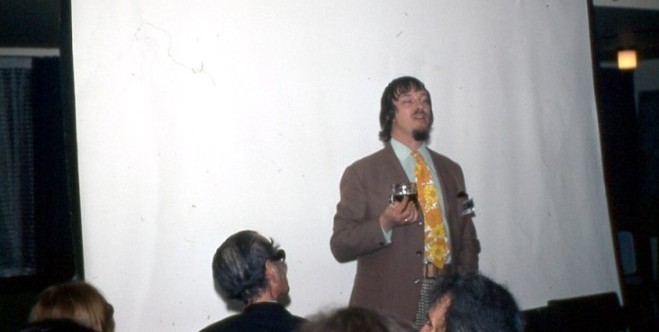
I dropped in on John Brunner's talk, which was its usual competent and interesting self. I would have stayed for Pam Bulmer's too but at that moment the bar opened, Bob Shaw appeared, and I was lost to alcohol and a Belfast accent. GRAY BOAK: I have yet to-receive confirmation that John said "CYNIC wha none"- whatever that may mean - during his speech... but I heard it! Pam's speech was rather disappointing, but that seemed largely due to her inexperience in public speaking. I look forward to reading it in QUICKSILVER.
ETHEL LINDSAY: I liked Worcester; and was fascinated by the view from the hotel lounge, The hotel faced Worcester Cathedral, very imposing with its high tower. It looked especially majestic at night when it was floodlit. Right in front of it was a very modern roundabout carrying major traffic. Quite a contrast. I was talking to Betty Rosenblum when she mentioned that there was the Worcester Porcelain Works nearby; and that it was possible to visit it. I pricked up my ears at this, for I love good china and I've always preferred Worcester china to all the others. So it was arranged that I should join Betty. In the end we set out with her family, Wendy Freeman, and Don and Elsie Wollheim. We lost Don early on but Wendy, Elsie and I were enthralled. We spent ages there and came away reluctantly.
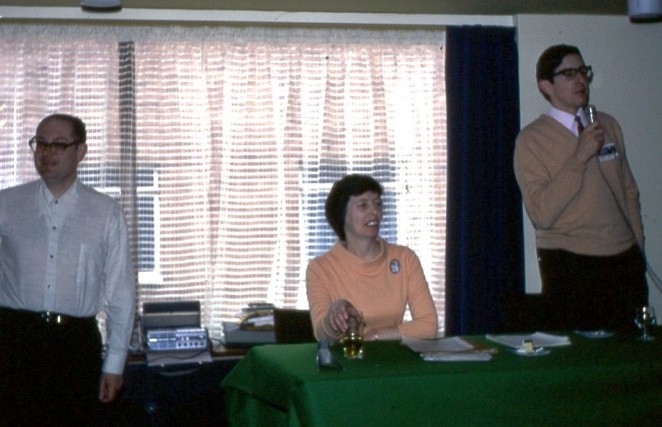
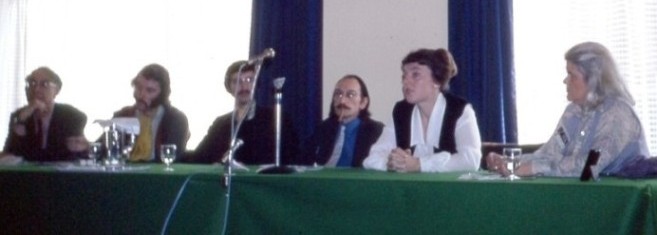
When we came back I found that there was a hue and cry going on for me. It seems that the fanzine panel was due to start. It wasn't that I had forgotten about it: but I had thought it was scheduled for the afternoon. "Some GOH!", said Pete. I did think, though, that the fanzine panel was not half bad, certainly better than many I've heard. On the whole panels to do with fandom are rarely a success. I wonder why? Goodness knows it is a subject we mull over often enough in the fanzines. Perhaps it is a subject that lends itself to discussion only in a small group.
(("Fanzines Past and Present", was a fascinating snapshot of a specific moment in time when what we now think of when we recall 1970s fandom was just starting to emerge. This was followed immediately by the auction....)) ROJE GILBERT: The auction was a tragedy. Many good items went very cheaply. I wonder if fans have so much money these days? I bid 20p for "The Worlds of Robert F. Young" and no-one even spoke. I considered this a fairly worthy item when I first read it, and to pick up an SFBC edition in very good nick, just sans dust-cover, seemed robbery.
GRAY BOAK: John Berry ventured the opinion that it would be worthwhile buying up material at a British auction and taking it to sell in the States. He suggests that the cost of the fare over could be covered quite easily. I did notice that some of the material went for low prices simply because the interested persons were not present -I particularly remember an autographed copy of "Wasp" going for a pound: there was no sign of either Keith Bridges or Arthur Cruttenden, who would gladly have doubled that. There was a very brisk trade in fanzines - a healthy sign? - one poor neo paying 35p twice for seemingly identical bundles of OMPA zines. Poor fool. However, this was halted by Rog Peyton, who proceeded to sell handfuls of sf at 3 to 4p each. I only hope that he runs his own business along better lines than he did the auction!
JOHN D. BERRY: I arrived on Saturday, the second day of the con and a day later than I had intended. But then nobody except Pete Weston had any inkling that I was coming, so the surprise was just as great one day as the next. Indeed, I did surprise quite a number of people although I'm sure the majority of the convention members took no note of my arrival. If it had been a small, intimate, convention instead of having over 400 registered members, and if there were now anything like the contact between British and American fandoms that existed in the 50s, I might have surprised many more people. But then I probably would have had to meet many more people and my contact with each would have been more superficial. As it was, the people I saw most were those I had met when I was in England two years ago and those I knew by their fanzines whom I had not yet met. The opportunity to appear unexpectedly came from my being in France to study for six months. I took a very complicated series of trains, buses and planes to London on Friday, but the journey took much longer than I had expected and I had to spend the night in London. The next morning I took another train to Worcester. On the way I met an utterly fascinating man, very sharp and in his fifties, I'd judge, who struck up a free-form conversation with me in the dining car, and we were soon talking as if we were old friends. We talked all the way to Worcester and, besides the obvious benefit of meeting someone new and fascinating, the encounter limbered me up for conversation. It was the best possible preparation for a convention, and consequently Saturday was my best day at the con. The very first person I saw in the con hotel was Pete Weston, who looked precisely like a harried con chairman. It wasn't until some time Sunday night that I saw him relax, have a drink, and join the party; by then it was undoubtedly past that point I've heard so many con chairmen talk about, when you say "It's out of my hands now, the hell with it!" Pete's wife Eileen provided a humanizing balance, but I don't think she had Pete to herself very much that weekend. After paying twenty-five shillings registration fee and picking up the very handsome, programme booklet, I went up to the lounge and into a crowd of not-quite-familiar faces.
I've seen enough photo-pages from past conventions that the crowd didn't look all strangers, but there was at first no-one I knew. Then one of the faces came into focus -- it was Darroll Pardoe, hiding under a heavy beard and long bushy hair the clean-cut Englishman he had seemed' at the Baycon and Midwestcon three years ago. Darroll, his wife Rosemary, and along with a number of young fans whose names I'm afraid I've forgotten, set off to find some lunch, but we found a Wimpy bar instead. A Wimpy would make me feel right at home -- if I were in the habit of eating overcooked McDonalds burgers, And calculating food prices brought me up against one problem that would plague me all weekend. From one trip to England two years before, I had just about mastered the British currency system. Now they've changed it and while in theory a decimal system should be easier for an American, in fact it was more confusing than ever, trying to keep in mind that one New Penny is worth 2 2/5 American cents (and 2 2/5 old pence). Since the system had just been converted, most of the English were hardly more adept at it than I, and they kept converting back to old shillings and pence, whicn only confused me more.
ROJE GILBERT:
By the time I got out for lunch, the pubs were shut, and I had a sandwich
lunch with the Bulmers and the Westons. Ken was very dejected, and Kept mumbling
about bargains. When pressed he said that Brian Aldiss had bought "Battle of Dorking"
in a local antique/junk shop for 30/-. Ken had offered him £2 and Brian had laughed
at him. I now realised that there are gaping gaps in my knowledge of SF and literature
far wider than I first suspected.
GRAHAM POOLE:
The afternoon session went somewhat haywire. When I entered, the
Convention Hall, the 'Science Fiction in the Cinema' item was
on earlier than programmed. Philip Strick was leading the discussion
in between films like 'The Day the Earth Caught Fire' and
others.
The last film was entitled 'Les Joux de Angles'** - 'Games the Angles
Play'. Philip Strick described it as a very sexual pornographic
film. I found it too baffling for words.
ROJE GILBERT:
Philip Strick showed that sick little film of his "Jeux des tinges"** in the afternoon. In
some unaccountable way it turns my stomach. Others were completely unaffected by it.
** [Bill Burns: These are both mis-hearings on the part of the writers. It's actually this film,
(("The Case For and Against Philip K. Dick" followed, with Strick for and Tony Sudbery
against.
Next came 'The Publishers Panel', chaired by Ken Bulmer: ))
ETHEL LINDSAY:
I was in the lounge and began talking to some young
fans. There had been some people at the con who had not registered at the
hotel and who had formed the notion of sleeping in the lounge. They were not
allowed to do so; and this was what we began to discuss. These fans could not
see why the freeloaders should not have been allowed to remain. They would not
say that there was anything wrong with someone coming to the con as a free
loader. I told them frankly that this was where I had to part company with
their thinking. I was brought up with a work ethic; was caught and imbued by
it too young to be able to change now. I can understand someone being caught
short by a financial crisis and just for once not being able to pay their whack.
I know what it is to be hard up, all right. What I cannot understand is someone
who thinks they have a right to freeload. Whenever I cannot pay my way I
feel guilty. I gather this is one of the fundamental differences between myself
and younger folks. But then they don't have my memories..such as being paid
6d for a day's work.
JOHN D. BERRY:
British cons don't seem to be markedly different from American ones. Because of the very
modern hotel and the record-breaking attendance, this one felt much like an American
worldcon. I suspect I could play the old con game as well there as in the States: guess
which ones are the fans. In the Giffard it was easy, because everyone was a fan but
for the hotel employees, but even on the street outside it required little effort to spot
the "fannish types".
Pete Weston told me that when he and Eileen were outside she pointed at a group of people
and cried out "There are some fans!" Pete looked and said that they weren't. "Oh, no," said
Eileen, "they're just people with very sensitive faces."
There were a few things about the con that reminded you that you were in England, not
in Ohio or California or New York. I found that I had much less trouble understanding
British accents than I had had two years before; but by the end of the weekend I had
picked up equal parts of English sentence structure and a Northern Irish lilt. There
seemed a more unanimous emphasis on alcohol there than at the typical American convention,
where a great number of fans are heads, yet Sadie Shaw remarked that there was much more
emphasis in America on hard liquor, as opposed to the plethora of British beers. (Of course
her experience with American cons was Southgate in '58, which was well before the current
wide acceptance of drugs.) At any rate, I spent most of the weekend drinking Guinness,
with a couple of pints of bitter as embellishment.
"Picking up bad habits, are you?" said Bob Shaw, who had introduced me to Guinness two
years before.
I travelled in diverse circles at the convention, and they didn't always overlap. James
White and Bob and Sadie Shaw were there, and I talked quite a bit with Sadie, but on the
whole I was surprised how little time I spent with them. For that reason I hoped to visit
Northern Ireland again before I left Europe. I met Ella Parker and Ethel Lindsay manning
the registration desk (and as a result left Bob Shaw standing in the hall). "Wee Ethel"
seemed to me about the way she ought to be: small, Scottish, and possessed of a very keen
mind. Ella is short, stocky, short-haired, and forceful, a personality to be reckoned with
in British fandom; I spent a fair amount of time at a party later that night barricaded in
a corner talking to her, dissecting fandom old and new. Ella and Ethel are old hands at
conventions and come prepared, as I found out when they offered me a cup of tea and some
sausage rolls at around five in the morning.
But most of the con I spent in the company of young, British fandom, in one form or another.
I renewed acquaintance with Graham Boak, who is now becoming a Fanzine Editor again. I met
Peter Roberts, slight, long-haired, usually wearing bright yellow overalls, and encouraging
me constantly in my appreciation of Guinness. Pete is starting up CHECKPOINT as a newszine
for British fandom, to fill the gap that has existed since SKYRACK disappeared.
Then there was the FOULER crowd. This is the two editors of
FOULER, and perhaps John Hall,
who seemed to belong. (I believe John publishes his own fanzine or is planning to, as it
seems every young British fan does. One issue, two issues, a bit of talk at several
conventions, and you're inscribed in the annals of British fandom. FOULER is a phenomenon
that has stirred up British fandom in recent months, with no knowledge of it sloshing over
into American fandom. The fanzine has seen four issues, all of which were given to me,
autographed by the editors, at the convention. The tone is brash and rude, and by attacking
current fandom in his editorial in the first issue, Greg Pickersgill drew a lot of fire by
return mail. The attack was contradictory and never entirely serious. Greg used the same
tone in person: young and with a fuzzy beard, he stood at the bar with a rum Coke in his hand
and pontificated, always needling and always changing his targets or tossing off remarks about
how unserious he was. He's quite a contradictory fellow. The effect of all this in print is
to make a sloppy, angry, whimsical fanzine that has drawn more response from its 50-person
mailing list than almost any other fanzine. FOULER is the closest thing to a focal point that
British fandom has, yet it's an adolescent focal point, filled with excesses for the sake of
excess. Curiously, Greg and his co-editor Roy Kettle seem to want a return to "fannishness"
and yet they've become involved in a paper feud with Darroll Pardoe, the very man who for
years has taken the brunt of young fans' attacks for being a pre-historic fossil, crying out
for a return to old-time fannishness.
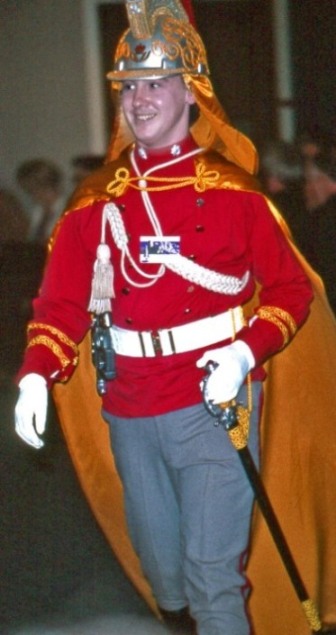
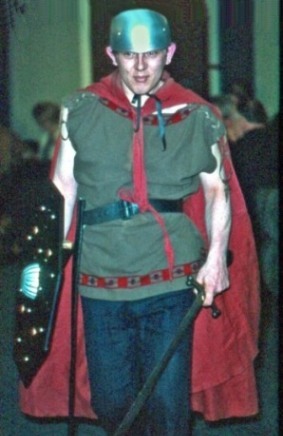
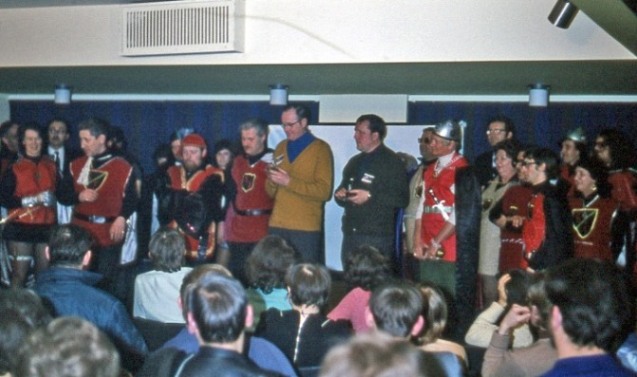
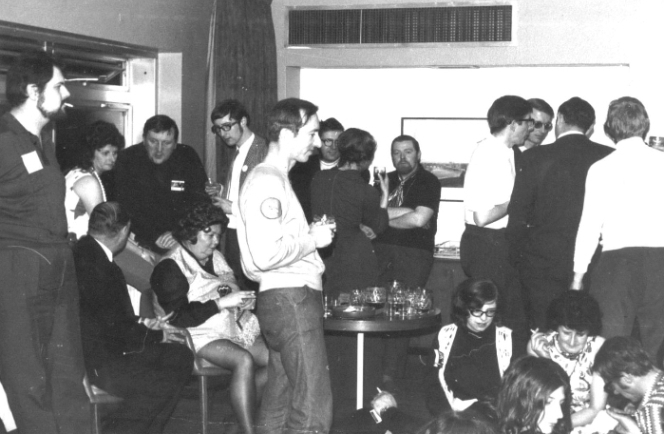
Or Roje Gilbert, staring lustfully at the fair Lisa Conesa, and at Phil Muldowney, hovering near her as always. "No chance," I said. "Look here, Boak," he said, "you just don't understand the way of these things. It's not your fault, you can't help it, but just watch this." And off he strode across the room. I was then distracted by Ian Maule, who wished to inform everyone that he had his arm around A Married Woman. When I (later) turned my attention to the fair Lisa, Phil was hovering over her as always, and Roje was angrily knocking back a pint with a grinning Vic Hallett. It's not surprising that the St. Fantony party was memorable - the sight of the stainless steel bucket that held the punch must have cheered the room by itself, and as for the sight of Norman Shorrock upending bottle after bottle of red wine and vodka to fill it - and again ...and again.....it was a good party. EDDIE JONES: On the party scene, the most successful was the Saturday night party thrown jointly by the Knights of St. Fantony and Heicon. It was an open party in the Giffard Suite and the only stipulation for attendance was that you had to be a member of the convention or attended Heicon or not attended Heicon and had your own glass. The party started after the St. Fantony ceremony and finished around 5:30 Sunday morning... the booze ran out about 4 in the morning and every member (as far as I know) had at least one pint of Vodka Punch...it was one of the high spots of the convention.
JOHN D. BERRY: The wee hours when the party had thinned out saw James White and Tom Schluck dancing (at first with each other), followed by tea and coffee for sobering and waking up. Still later, James and I accompanied Ella and Ethel to their room for winding down and small scale fannish talk. James told us a bit about airplanes, since he works for an aircraft manufacturer. "At my job at Short's I've come to understand much more about airplanes," he said. "It's not very reassuring." "That's not very reassuring either," said Ethel. GRAHAM POOLE: I was afraid of being locked out, so at 2.30am I left the party, reluctantly. Later Roger Gilbert told me that he left it at 3.45, and wandered around with Pete Weston looking in the rooms to see if everything was OK. At least, that's his story. VERNON BROWN: After Friday afternoon my recollections of the con are a bit hazy, with lumps of memory like islands. As I never got to bed until 5ish and was up at 8am this perhaps is to be expected. The majority (99%?) of my drinking was done after midnight - I remember on, was it the Saturday night, drinking with Rog Peyton until about 2am in the morning when, undoubtedly due to the larynx lubrication we'd bought him, the barman pulled down the bar partition, isolating it from the lounge - with us on the *bar* side. Not wishing to be unfriendly we consumed innumerable shorts and sandwiches until about 5am when, after climbing over the bar, we made our way out via the emergency exit. A few minutes later, after glancing round the con rooms for sleepers, I was standing by the main entrance when two of the local constabulary, curious at such late night revels, strolled up for a chat. Have you ever tried to explain a science-fiction convention to a non-fan even when you're *sober*, which I don't think I was? However, they didn't run me in or commit me and I wandered off to bed.
| ||||||||||||||
|