Sunday 29th March - [Programme]MERV BARRETT:Now it was morning and light had come to the outside world. Around me in the 7am gloom chairs creaked and thick morning-after voices, seemingly unrelated to the rag doll-like postured bodies distributed around the room, called to each other. Somebody, the projectionist I suppose, said "I’m going to run THE TRIP again if anybody wants it." There were moans, but whether of terror, resignation; or encouragement I couldn't decide. I strode off towards Euston Square Station and my train feeling, as I do on these rare occasions, rather smug and superior at being up and out on a Sunday while most of the rest of the population are lying asleep. Here I was, braving the cold: a man with a purpose, even though that purpose was nothing more than getting home and going to bed for a few hours. With some time to kill before my train was due I decided that a coffee and a Sunday paper would be a good thing, so headed into Euston Station, It's the new Euston Station, but its modern facade and pseudo-air-terminal concourse do not conceal its general British Rail-type crumminess. Around the walls, on the terrazzo floors, huddled in blankets, sleeping bags or just lying on newspapers were people still sleeping or newly wakened. There were men and girls - mostly itinerant Irish workers waiting for the ticket offices to open; and the trains to arrive that would take them on the first leg of their journey back home.
Unlike the older stations where vagrants and stranded travellers alike can stretch out through the night, the new Euston Station has no seats, "If you put in seats," the argument against them goes, "people will only sit on them." This would, of course, spoil the clean modern lines of the new terminal. One is only surprised that the station is not kept locked 24 hours a day. A few window dummies, carefully placed to match the blobs on the architect's rendering, would be much more in keeping with a school of design which sees people as either an irrelevance or a nuisance.
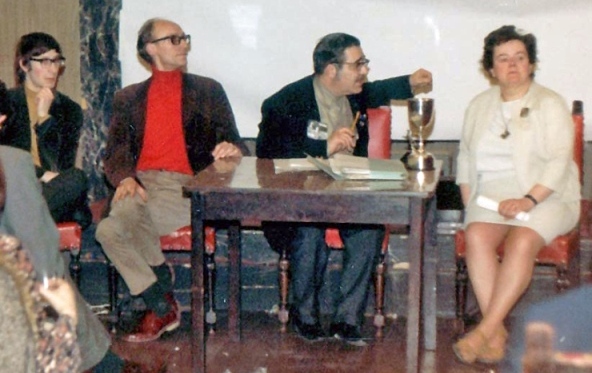
ARCHIE MERCER (on BSFA AGM): To anticipate the official Minutes, five members of the Management Council retired under the rotation system Brian Aldiss, S.R. Dalton, Archie Mercer, Beryl Mercer, and the Chairman, Bruce ("Edmund Crispin") Montgomery. Three of these five (Aldiss, Beryl Mercer, and Montgomery) did not wish to stand for re¬election. The other two, Dalton and Archie Mercer (speaking!) were re-elected. Also elected to the Council were E.J. Carnell, the well-known editor, and Roger Peyton, one-time editor of VECTOR who has rejoined the Association and been given specific responsibility for publicity. The astute amongst you will have deduced from the above that the Association no longer has a Chairman, This post is filled by the Council from among its own number, and the new Chairman's name will be announced shortly. For the first time in living memory (so to speak), there were three parties interested in staging next year's convention. A group from the Manchester area (which ran the 1968 convention at Buxton, Derbyshire) wanted to hold it in either Blackpool or Southport, depending on what terms they could get from various hotels, whilst a "loner" from Bournemouth had a specific hotel lined up in Swanage, Dorset. The vote, however, went to a group from Birmingham who thus have the go-ahead to arrange next Easter's sf convention either within or without that city, again depending on what terms they can get from various hotels.
And the retiring Chairman, Bruce Montgomery, was voted by the meeting into a Life Membership in the Association. PERRY CHAPDELAINE: P.J. Hills of the University of Surrey gave a talk on Teaching Systems, Present and Future - a Multiple-Image Tape/Slide presentation. Dr. Hill was indeed a fine chap, and his subject well-received, but, like much English technology, was considerably behind American efforts. (On balance, English applied sociology is far in advance of American.) PETER ROBERTS: Breakfast is taken with Roy, Arthur, and Ian (I think, but am not entirely awake, so...). I make my way to the Con-bidding, however, and am surprised to hear of three bids for 1971; Bournemouth (Brian Burgess) , Southport (Harry Nadler), and Birmingham (Pete Weston), The latter is successful on open show of hands (ah, the joyful and absurd difference from Worldcon bidding!). Four or five bids are then made for 1972 - an unusual display of enthusiasm. Pete Weston tells me that afternoon that he has received some 75 registrations for the Brumcon...not bad for first day.
A lunch expedition forms as we walk off to Indian Restaurant of some cheapness, but considerable interest. Mulligitawny soup, vegetable curry, and lychees are consumed in the company of Ken Eadie, Brian Hampton, Roy Kettle, Greg (missing the mock Wimpey and sitting surly and foodless), Ian Williams, and Nigel Haslock, moustachioed, gun-slinging, and expressing interest in games - this leads to a complex game of multiple noughts and crosses on a serviette (v. Brian). The waiter watches suspiciously. PERRY CHAPDELAINE: Two p.m. Keith Albarn, veritable genius of spatial structures, gave a fascinating talk mixed with random movements of slides projected on screen, each showing some of his past work, usually in fibre-glass. I hope to see and work closer with Keith someday, but couldn’t possibly predict how or when. (Keith Albarn is the father of Damon Albarn, singer with the band Blur)) At three p.m. the most amazing phenomenon occurred. Raymond Fletcher, M.P. (Member of Parliament - one of the seven strongest this year - holding power combining our representative, senatorial and executive offices) rose and gave a resounding speech, in high British tradition, of need for science fiction writers in government. Happen in America? Not hardly. I eagerly await the transcription of his speech.
Earlier I had had cocktails with Raymond Fletcher at Poul Anderson's bar. I casually mentioned a project I'd been studying and promoting in America for nearly a year, having to do with bringing SF into the educational structure of the schools. He hopped on the idea, phoned his wife that he would be late that night, and made me go to George Hay's office to type up a summary of it. That summary, he said, will- be. brought to the Ministry of Education and will be titled "The Chapdelaine Papers". In my own little way I've now proudly become part of the 700-year-old tradition of the British Empire. He intends to follow up on the idea and, if successfully introduced, I might get invited back to help build on it. That could never happen in America! As long as he was relaxing - which I understand he very rarely does - he stayed with me until 4:00 a.m. that morning. Rather, I went to bed at 4 and he stayed until 5:00 a.m. PETER ROBERTS: Back to the convention to listen to 'I'm Sorry I'll Read That Again' and then out to an afternoon tea with Mary Reed, Charles Legg (always somewhat reminiscent of an Old English sheepdog), Alan Chorley, and others. I play an amazing Japanese chess with Nigel Haslock; total confusion exists, since I am unable to recognize pieces, let alone adapt to the un-British idea of replacing opponent’s taken men whenever and wherever wanted. More puzzled waiters watch warily. Return to auction.
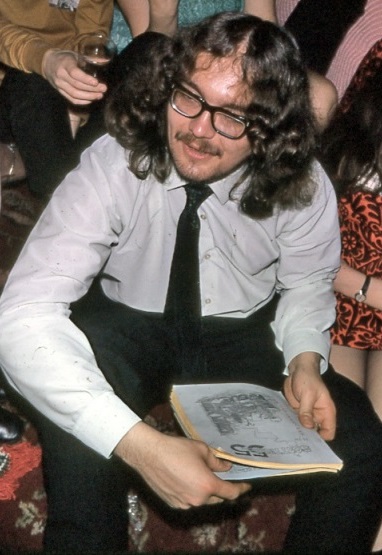
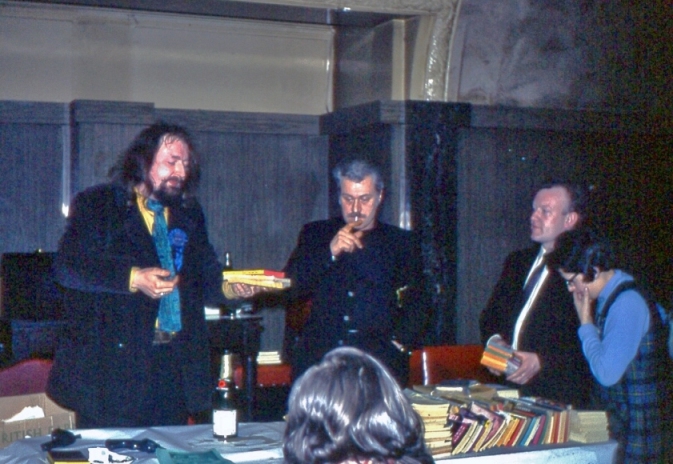
ROGER PEYTON: That was the auction, with me at the side sorting the items into suitable bundles for Mike to sell. These were the days before I had the nerve to do it myself. Mike did a few auctions in those days. Anyone know the day and time for this programme item? I'm wondering why I'm wearing a tie. PETER WESTON: We always wore ties in those days! You stopped with 1971, I carried on a bit longer before lightening-up. MARK PLUMMER: The schedule was: 15:30 Auction 16:15 Tom Morgan, Scientologist in the con hall and Tolkien Society Meeting in foyer ROGER PEYTON: Thank you Mark. That solves the problem. Sunday lunchtime, Arline and I went to an expensive Hotel up the road for lunch, and tie and suit were stipulated dress code. I'd obviously hurried back from lunch for the auction and not removed that offending object. Despite what Pete thinks, I never wore a tie unless absolutely necessary.
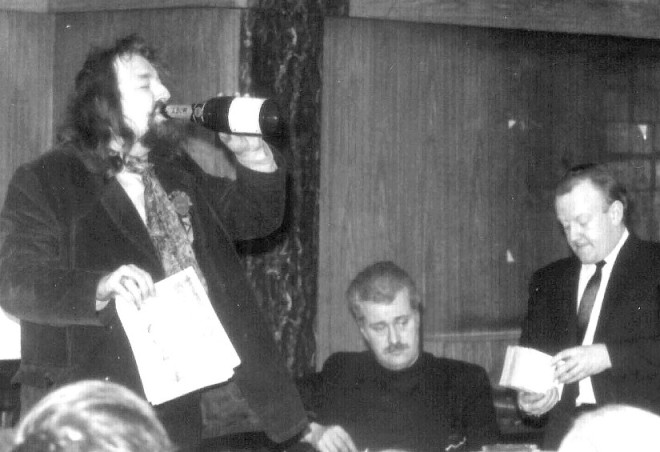
PETER ROBERTS: Ken Eadie is buying everything Mike Moorcock, Ted Tubb, and Ken Bulmer are selling. But not a full set of HYPHEN which goes for £5 - I watch with clenched teeth and empty pocket. John Muir is even more heartbroken at the sight, but later alleviates woe with some cheap 'Golden Age' fanzines from the U.S. I wander into a Tolkien society meeting and am commissioned by Keith Bridges to draw aardvark badges - I retire with pen and am quietly fruitful. The auction is restarted, Mike Moorcock and companion remaining in an attempt to sell various objects. A heated bidding for a Mike Moorcock Fleetway comic manuscript is held between an inquisitive fan and MM - the latter buys it for 11/- and tears it into small pieces to erase its memory. A signed whiskey bottle fetches no interest, whilst a box full of oddments (including Aldiss and Ballard manuscripts) disappears for £10. I look miserably on. JIM LINWOOD: Looking back I have rather negative feelings about SciCon, particularly as one of the opening speakers was a Scientologist who said "Unfortunately Ron can't be with us today..."
MERV BARRETT: Chairman George Hay had once been quite involved in Scientology and organizing a Scientologist had been one of the first programme moves he made. His intent was, he claimed, to stir things up a bit. If that was his intent then it just didn’t quite come off. Scientologist Tom Morgan faced a largely hostile crowd and speaking haltingly he gave a dull rundown on Scientology that was something like " ... and then in 1953 Ron decided to invent Scientology." When he’d finished George Hay called for questions and up jumped Perry Chapdelaine. I'll try to give you some idea of the dialogue that went on between him and Tom Morgan.
"My name's Perry Chapdelaine and I'd like to say something here." This sort of thing went back and forth for a while with George Hay butting in now and again, trying to get some agreement, and eventually Perry got to have his say. He told how he'd worked with Hubbard in the days of Dianetics and at the beginnings of Scientology. When he'd completed this chronicle of questionable practices Perry paused and then announced "Scientology is a hoax."
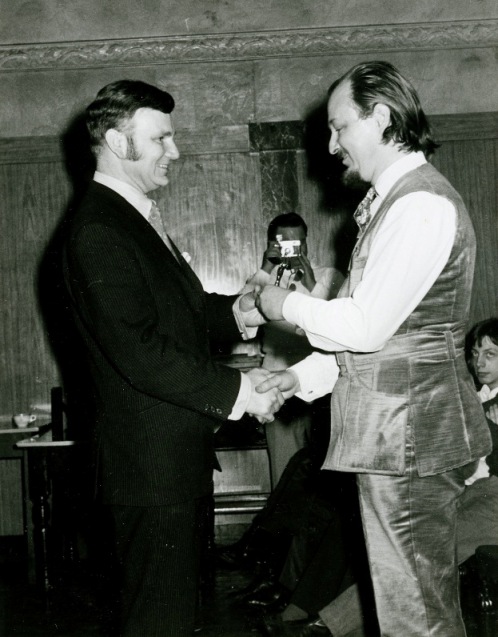
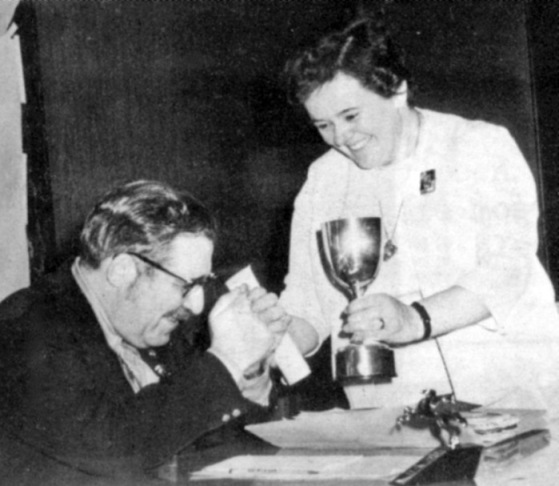
There was loud applause after this and George Hay stood up and said something like "Well, I'd like to continue this but we've run out of time and John Brunner's ready with his panel. John, would you be prepared to hold off for a little while?" "I don't mind," said John, "as long as you're through by 5.15." As it was then 5.10 he had established that he was clearly unwilling to have any of his time taken up by waffle about Scientology. His team of three lecturers from the London. School of Economics came forward and with John in the chair the subject "Progress is a self-defeating spiral" was put forward. But not very successfully, I thought. PETER ROBERTS: Play bad bridge with Nigel Haslock, Ian Williams, and Howard Rosenblum. Time passes. Ian and I talk vaguely to Lang Jones about his revised TITUS ALONE - due out from Penguin end of April. Gunther involves embarrassed Roy and Greg with two Swedish girls, one of long blonde beauty. Ken Eadie is stricken and moons the evening long, watching Gunther converse happily in native tongue. Sad, eh? ARCHIE MERCER: The revived British Science Fiction Award for 1969 was presented to John Brunner for his "non-novel" "Stand on Zanzibar". Our very own Vice Chairman (and ex-officio Chairman of the Committee), Michael Rosenblum, officiating at the award-giving, was surprised to find himself the recipient of the "Doc" Weir Memorial Award - given annually for unspecified services by vote of those registered for the convention. To both of these winners the Association extends its heartiest congratulations.
PETER ROBERTS: 'Things To Come' emits warped noises and plays painfully to a large house - I watch favourite excerpts, but rest mostly by the bar. Gerald Bishop is encountered, lean and bearded; he attempts to sell checklists... whoa-no! A party is announced later, of large size (seventeen, would-you believe). Arthur, Keith & Jill Bridges, Nigel Haslock, Rosemary & Darroll, Brian Hampton, and many others. I sight upon a stray cucumber and devour same with hunger and joy, impulsively throwing lower end out of the hotel window. There is some noise and voices. A fan bearing the cryptic name-tag "Rubber-Boots"** leans out of window, looks down, and happily informs me that I have just thrown the cucumber through an open window in a mews opposite. I peer out - a woman in nightdress is waving fist through an open window and yelling incoherently. I answer to the best of my ability? "Leide kann ich Sie nicht verstehen, gnadige Frau!" and slam window shut, leaving party before I do further damage. A game of hurdling or corridor racing is going on outside, but I make my way hurriedly to the bar to recover with a Guinness or three. Later I return to the party, there to sing aardvark and axolotl songs ('The hills are alive with the sound of aardvarks’ and such). I inscribe badge on decorated leg of unknown femme fan. Back downstairs again, the bar has closed and I am drinkless; I sit and chat to Archie & Beryl Mercer, and others. The remains of parties trickle down - Ted Tubb's wine is seen, I gesticulate thirstily and Ken Bulmer recognizes serious nature of plight and sends aid. The result is too much, for I stagger off to bed. ((** This is Dave Rowe, Bram Stokes having christened him that because of his refusal to wear leather, Dave being a strict vegetarian. - Bill Burns)) Four hours later....
| ||||||||||||||
|