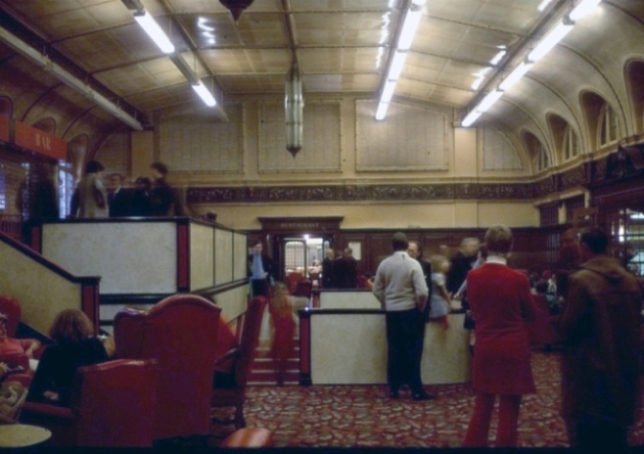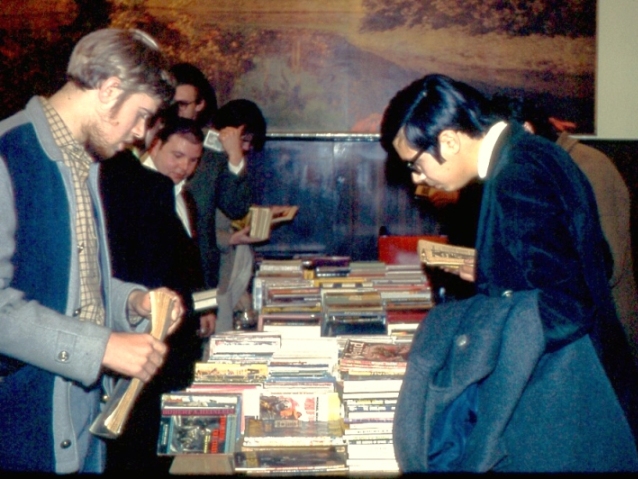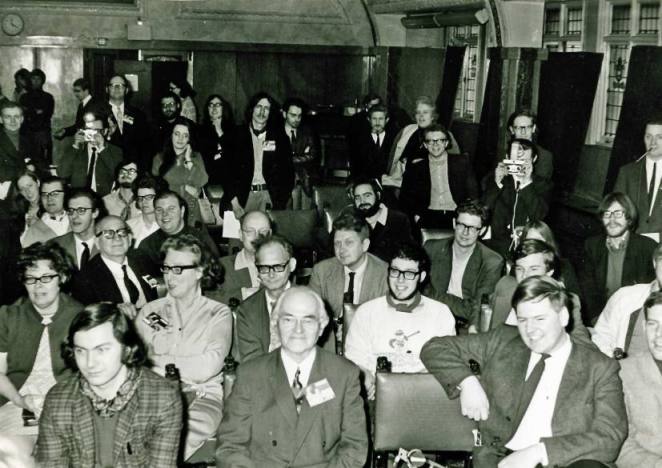
con audience (key to audience members here)
|
MERV BARRETT:
The Con programme started, traditionally a little late, on Friday
afternoon. Chairman George Hay introduced the rest of the committee and
gave a halting little speech on the coming of age of science fiction and
its importance to society.
Variations on this theme were rung by the first
guest, Professor Willis McNelly of California State College, who stressed
the 'literary' qualities of recent stf, singling out for special praise
John Brunner's STAND ON ZANZIBAR, and was almost equally generous towards
the works of Brian Aldiss. Both of these gentlemen were sitting in the
front rows at the time.
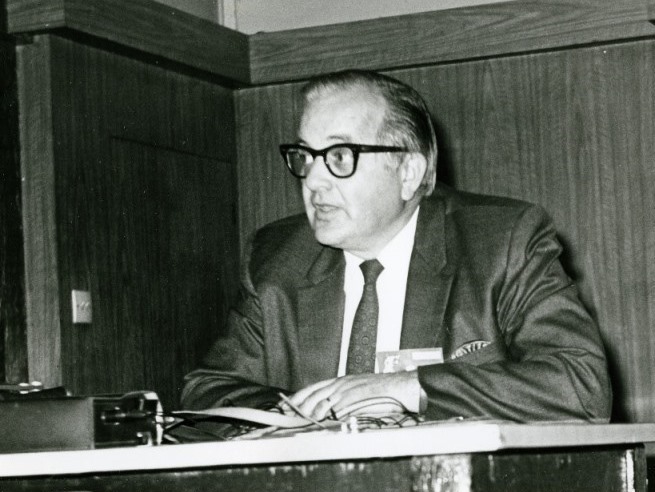
Professor Willis McNelly (gh)
|
A theme of his talk was the idea that the devices that science fiction
draws on are now common property and can be used by writers outside the
field without acknowledgement in the way that a story can be, quite
legitimately and without fear of anyone crying 'Plagiarist', based on, say,
Shakespeare's HAMLET, He gave no examples of any important novelists that
were doing this though, and the people he singled out for praise during his
talk, Brian Aldiss and John Brunner for instance, are writers from inside
the field who, because over the years they happen to have been getting
better in all directions, have received attention for a non-regular-stfreading
public.
PETER ROBERTS:
Back to Con Hall; announcement of hunger. A group of fans is formed; John Hall brays contentedly
at Roy Kettle who is still talking, Greg Pickersgill watches; Alan Chorley smiling quietly and
wisely, and David Redd clutching a Deegan Grey Mouser with wide grin of anticipation. We walk four
times around London in search of a Chinese Restaurant which turns out to be invisible. A mock
Wimpey Bar is found eventually and claimed. Eating takes place (of egg & chips and apple strudel
for extravagance).
Back to the commencement of drinking and choking dismay at lack of Draught Guinness. I gracefully
accept a bottled variety from Coke-fiend John Hall, however. Then to the Registration room for
Mercatorial arrival and meeting with, youthful comic-fan, Dave Womack (clutching a brief-case,
later discovered to be full of old ZENITHs and FANTASY COMMENTATORs - destiny unknown). Rob
Holdstock towers over me and talks of future goodies for MOR-FARCH. Promises, promises... I
amble outside and into the entrance hall where John Brunner is chatting audibly and expressively
in French. Brian Aldiss arrives and is fairly surrounded.
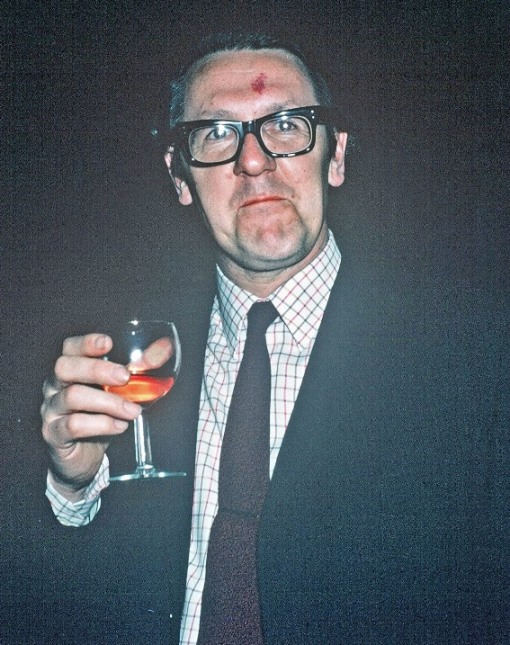
Brian Aldiss (mb)
|
Drinking is resumed. Hello to newcomer Philip Cooper resulting in copy of MULT, also to Howard
Rosenblum with pipe, camera, and SoNF, Talking to Gray Boak who disappears with whoop to embrace
newly arrived Pat Henderson of boots, long hair, and large American smile. Jack Marsh enters with
lady wife and, smiling wryly, buys John Hall another Coke - I accept a Guinness with true fannish
spirit (corflu, naturally).
Drinking and convivial talk fills the evening - Bob Rickard with grin, Dave Berg rolling cigarettes,
Geoffrey Cowie looming with uneasy happiness, Hartley Patterson quietly amused under beard... Too
soon the need for urgent retiring hits stomach and head; I clutch nose-flute and stumble out.
MALCOLM EDWARDS:
Apart from a couple of visits to the Globe -- this was my first fan
event outside Cambridge. I spent an evening in 1970 talking to Perry Chapdelaine
and George Hay (well, no one else would talk to me) and was amazed and disheartened
to discover at my first sf convention someone who seemed to share the most
rebarbative attitudes of my parents' most conservative friends.
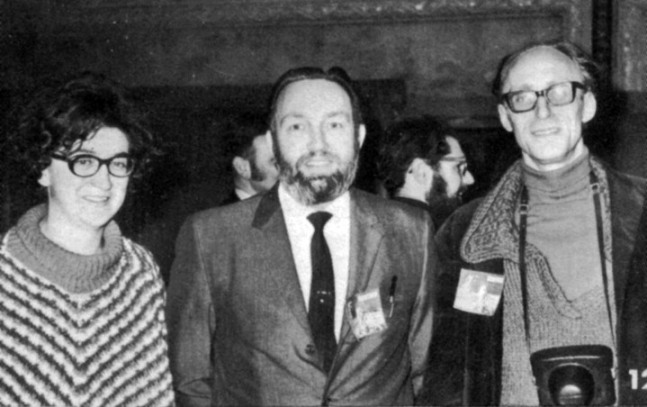
Christine Hay, Perry Chapdelaine, George Hay
|
PETER WESTON:
Great word, 'rebarbative', I must try and work it into the
conversation down at the Rotary club.
Mention of Perry Chapdelaine (with whom I was NOT impressed back in
1970; he latched on to me, too) reminds me that he spent a lot of time
telling me about the 'conspiracy' that was preventing work by authors
like him from being published.
MERV BARRETT:
That evening Philip Strick showed an extract from THE BIRDS and talked
some about Roger Corman and the film we were to see - THE TRIP, This movie
has been going the rounds of the film clubs for a year or two now but was
refused a censor's certificate for public showing. Mr. Trevelyan
(Secretary of the British Board of Film Censors from 1958 to 1971) seemed to
think it might encourage people to experiment- with drugs. It's an interesting
movie and, as was to be expected, the sequences representing the
visions of a man in a drugged state were largely unconvincing, It was a
good offbeat choice for the Con, though, and it was the only feature film
shown which I, and I think most of those present, hadn't seen before.
Later, carrying foaming tankards of Harp Lager, I tip-toed back into the
Con hall. The exaggerated care was so I wouldn't disturb the platform of
poets assembled to read their works, "Tom Disch and I invented this form
when I was in New York and..." They were John Brunner, Edward Lucie-Smith
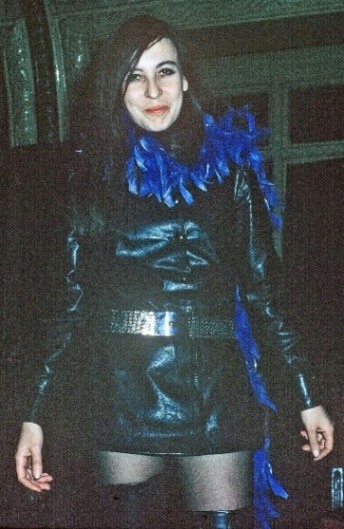
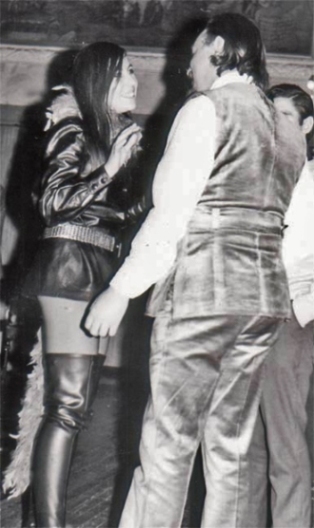
and a lady poet whose name I don't remember. Lady poets, I was pleased to
find, are young, great-looking, and wear black short-skirted dresses with
silver-buckled belts, black tights and thigh-high black boots, This one
wrote light-hearted little poems like for instance one about how to prepare
people for eating. It's the only poem of the session I can remember anything
about - sorry Edward, sorry John - and if this admission brands me as some
sort of Cultural yahoo more interested in ogling the singer than listening to
her song, then I can only raise my head defiantly and admit "Yep, that's me,
folks."
MALCOLM EDWARDS:
I must have known enough even then to avoid the poetry reading, and thus
missed the infamous glass-throwing incident.
PERRY CHAPDELAINE:
John Brunner led off on poetry. The only ugly incident occurred
when a certain publisher who disliked John got drunk and made nasty remarks.
Studiously ignoring the man, John plunged poetically onward. The drunk threw a
glass, cutting John's leg. Blood ran red, bright, down John's leg.
Did John scream and howl, and stamp his foot in anger? No, that would have
been the American way. John reached into his pile of poems and pulled out one
which just happened to describe someone as nasty as the glass-thrower. John read
it with relish, getting proper emotions and nuances into each line. The crowd
howled it up.
Somehow, the drunk never came back.
There was an exchange between Mike Moorcock and Peter Weston about the incident in SPECULATION #27,
and an account by John Brunner and commentary by James Blish in the following issue:
|
|